Amir Pousti

Engineering

How things work.
How to improve them.

Projects across mechanical design, materials, energy and control systems. I use analysis, simulation and experiments to understand performance, compare ideas and develop practical solutions.

Flagship project · Individual dissertation

Designing a lighter Formula Student suspension upright

How far can mass be reduced without losing structural credibility or manufacturing practicality?

I developed the load model, material screen, CAD redesigns, mesh-convergence study, finite-element analyses and machining-cost comparison across six design iterations.

Iteration 5 offered the strongest practical balance: 18.43% lower modelled mass, a 4.80 safety factor and an estimated machining cost of £75.53.

Selected mass 0.549 kg
Reduction 18.43%
Selected FOS 4.80
Est. machining £75.53
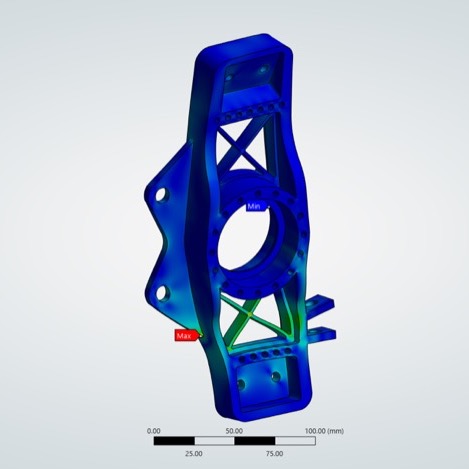
Finite-element stress result for the recommended fifth upright design iteration
Iteration 5 stress field 102.92 MPa
Recommended design · Best balance of mass, stiffness, and machining cost

02

Further engineering work

Finite-element analysis · Individual project

When a finer model changes the answer

Testing 72 mesh configurations isolated the effects of element shape, order and density on a loaded spanner. Refinement captured 42.9% more peak stress; quadrilateral meshes achieved comparable displacement with approximately 40% fewer elements.

Decisions and lessons
Decision
Vary element shape, order and density across 72 configurations.
Lesson
The mesh changes captured peak stress, while element choice also affects the computational cost of comparable displacement results.
Next check
Choose the refinement criterion for the quantity of interest and check whether local peak stresses continue to change.

Control systems · Laboratory project

Modelling and tuning a water-level control system

System identification, MATLAB/Simulink modelling and PID tests compared predicted and measured water-level response. The theoretical time constant was 127.2 seconds versus 138 seconds experimentally: an 8.4% difference.

Decisions and lessons
Decision
Compare the modelled water-level response with measurements before judging the PID tuning.
Lesson
The 127.2-second theoretical time constant and 138-second measured result show why a model needs experimental comparison.
Next check
A follow-up would repeat the identification at different operating points and quantify measurement uncertainty.

Thermodynamic systems · Individual project

Selecting a working fluid for biomass CHP

Steam and organic Rankine cycles were compared, then n-pentane, HFE-7000 and HFE-7100 were assessed against operating constraints. Sourced fluid properties remain distinct from original calculations; the study does not claim one universally best fluid.

Decisions and lessons
Decision
Screen working fluids against the cycle and operating constraints.
Lesson
Fluid choice depends on the system requirements; sourced property data and calculated performance should remain traceable.
Next check
Recheck property assumptions and practical operating constraints before making a final equipment selection.

Experimental heat transfer · Group project

Testing convection and radiation theory

A four-person laboratory study compared theoretical and measured heat-transfer coefficients under natural and forced convection. The team examined how error changed across operating conditions and what this meant for model validation.

Decisions and lessons
Decision
Compare theory and measurements across natural and forced convection conditions.
Lesson
The team’s results show that agreement can vary with the operating condition; one aggregate error can hide that pattern.
Next check
A follow-up would propagate measurement uncertainty and repeat the conditions with the largest discrepancies.

Structural testing · Group project

Measuring off-axis bending in a cantilever beam

A four-person experiment measured horizontal and vertical cantilever deflection at 0°, 30° and 60°. Several vertical results diverged from theory, highlighting the need to quantify experimental agreement.

Decisions and lessons
Decision
Measure both horizontal and vertical deflection at three beam orientations.
Lesson
Several vertical results diverged from theory, so agreement needs to be reported by direction and angle.
Next check
Recheck load alignment, measurement references and repeatability before assigning a cause to the disagreement.

Life-cycle analysis · Individual project

Cigarettes versus disposable vapes

A cradle-to-grave comparison examined environmental impacts, unit economics and stakeholder risks, bringing product life cycles and economic considerations into a single assessment.

Decisions and lessons
Decision
Compare the products across their life cycles, from production and transport to use and disposal.
Lesson
The functional unit and unit conversions determine whether the headline comparison is meaningful.
Possible extension
Test how different electricity mixes, transport distances and disposal scenarios change the comparison.

Infrastructure modelling · Individual project

Renewable power for an island system

An off-grid island model combined thermodynamic cycles, renewable-fuel supply, equipment selection and generation economics to assess renewable power options as a complete system.

Decisions and lessons
Decision
Combine generation, fuel supply and equipment choices in one island-system model.
Lesson
Generation economics depend on the relationship between energy demand, fuel supply and equipment performance.
Possible extension
Compare seasonal demand and fuel-supply scenarios to explore how the system responds to changing conditions.

Thermal optimisation · Individual project

A smaller heat exchanger—and its trade-offs

The model reduced area from 13.072 to 4.702 m² and tube count from 124 to 45, raising the heat-transfer coefficient from 200 to 404 W/m²K. The study examined how a more compact design changes thermal performance and flow requirements.

Decisions and lessons
Decision
Reduce exchanger size while examining the resulting thermal and flow trade-offs.
Lesson
A higher heat-transfer coefficient needs to be weighed against flow velocity, pressure drop and fan power.
Possible extension
Compare the designs across a wider range of operating loads and include lifetime energy costs.

Refrigeration analysis · Individual project

Locating useful-energy losses in an HVAC cycle

First- and second-law analysis located irreversibility in an R134a vapour-compression cycle, using coefficient of performance and exergy balances to examine component-level losses.

Decisions and lessons
Decision
Use energy and exergy analysis to locate useful-energy losses within the refrigeration cycle.
Lesson
Energy and exergy analysis offer complementary views of cycle efficiency and the sources of useful-energy loss.
Possible extension
Explore how operating temperatures and alternative refrigerants affect cycle efficiency and component losses.