Page
Viewport Desktop · Home

Amir Pousti

Engineering discipline.
Financial judgment.

MSc Finance, UCL · First-Class Mechanical Engineering

Finance

Businesses, markets, and value.

Selected work in equity research, valuation, financial modelling, markets, and capital allocation.

Finance Research Project · Individual · August 2026

Ferrari: Scarcity Is the Moat. Valuation Is the Constraint.

Can an exceptional scarcity-led business justify an exceptional valuation?

I built a 24-sheet operating and valuation model covering Ferrari’s historical performance, forecast drivers, free cash flow, beta, WACC, peer multiples, and dividends.

The original conclusion was deliberately restrained: the franchise was exceptional, but the blended target implied just 2.03% upside.

Original viewHOLD
Blended target€325.32
Market price€318.85
Terminal value75%
Download report ↓ Download Excel model ↓
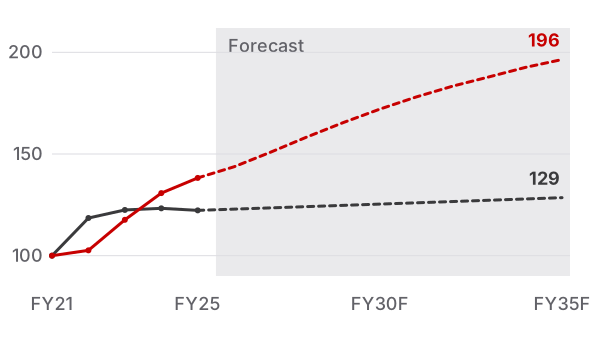
Scarcity shifts growth from volume to value
FY2021 = 100
Shipments Cars & spares revenue per shipment

By FY2025, shipments were broadly flat from FY2023 while cars-and-spares revenue per shipment had risen to approximately €440,000.

02

Financial projects

Financial statement analysis · Group project

Diageo before the deal

Analysed five years of margins, ROIC, leverage, cash conversion, and accounting policy, then built two-year forecast statements. FY2025 gross margin remained near 60% and free cash flow reached $2.69bn, while rising inventory days and impairments tempered the acquisition case.

Macroeconomic research · Group project

Did credibility make disinflation less costly?

Compared inflation, expectations, unemployment, and GDP around New Zealand’s 1989–92 regime change. Inflation fell from 9.28% to 3.23% as unemployment rose from 5.76% to 9.75%; later stabilisation supported credibility, although concurrent reforms limited clean attribution.

Corporate valuation · Group project

Reconciling Lennox’s competing values

Normalised Lennox’s statements, forecast five years of free cash flow, and compared DCF, peer-multiple, and two-stage dividend models. The blended value was $523.81 per share versus $511.42, while the wide range between methods made valuation sensitivity central to the conclusion.

Quantitative portfolio analysis · Group project

When the required portfolio does not exist

Built a mean–variance frontier for CMG, ORLY, MNST, and TSLA using five years of weekly data. The lowest attainable probability of earning below 8% was 23.07%, showing that the required sub-20% downside constraint was infeasible for this asset universe.

Fixed-income research · Group project

When a rating changes the risk it measures

Synthesised evidence on regulatory certification, rating triggers, and capital-structure responses to examine how ratings can alter funding costs and amplify default risk. Firms rated more favourably by DBRS experienced a nearly 55bp yield reduction after its NRSRO recognition.

Derivatives modelling · Group project

Pricing an S&P 500 option through a binomial tree

Used 252 trading days of S&P 500 and Treasury-bill data to estimate 18.57% annualised volatility and price an at-the-money European call with CRR trees. The illustrative time-varying two-step model produced $256.59 versus $252.20 while relying on ex-post parameters.

Engineering

Modelling, testing, and optimisation under real constraints.

These projects show how I break complex systems into tractable models, test assumptions against evidence, and make trade-offs between performance, cost, risk, and feasibility.

Flagship project · Individual dissertation

Designing a lighter Formula Student suspension upright

How far can mass be reduced without losing structural credibility or manufacturing practicality?

A six-iteration design study combining vehicle-load analysis, material selection, finite-element modelling, mesh convergence, geometry optimisation, and machining-cost analysis.

Selected mass0.549 kg
Reduction18.43%
Selected FOS4.80
Est. machining£75.53
Download report ↓
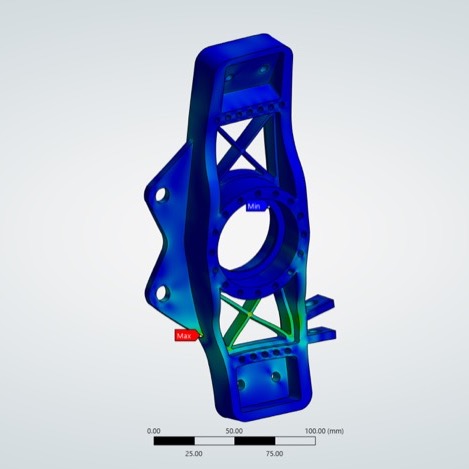
Iteration 5 stress field102.92 MPa
Recommended design · Best balance of mass, stiffness, and machining cost

02

Engineering projects

Life-cycle analysis · Individual project

Cigarettes versus disposable vapes

Mapped cradle-to-grave impacts, estimated unit economics, and stakeholder risks across materials, manufacture, transport, use, and disposal. Comparative results remain in revision while the functional unit, electricity conversion, transport assumptions, and headline comparisons are recalculated.

Finite-element analysis · Individual project

When a finer model changes the answer

Tested 72 mesh configurations to isolate how element shape, order, and density altered stress and displacement estimates in a loaded spanner. Refinement captured 42.9% more peak stress, while quadrilateral meshes produced comparable displacement with approximately 40% fewer elements.

Infrastructure modelling · Individual project

Renewable power for an island system

Integrated thermodynamic cycles, renewable-fuel supply, equipment selection, and generation economics into an off-grid island-system design. The model is being rebuilt and independently unit-checked, so no cost-per-kWh result is presented yet.

Thermal optimisation · Individual project

A smaller heat exchanger—and its trade-offs

The model reduced required area from 13.072 to 4.702 m² and tube count from 124 to 45, while raising the heat-transfer coefficient from 200 to 404 W/m²K. Velocity, pressure-drop, and fan-power outputs remain under review.

Control systems · Laboratory project

Modelling and tuning a water-level control system

Combined open-loop system identification, MATLAB/Simulink modelling, and practical PID testing on a water-level rig. The theoretical time constant was 127.2 seconds versus 138 seconds experimentally, an 8.4% difference.

Refrigeration analysis · Individual project

Locating useful-energy losses in an HVAC cycle

Applied first- and second-law analysis to an R134a vapour-compression cycle to identify where irreversibility concentrated across the system. The COP and exergy balance are being reconciled, so numerical results are not yet published.

Thermodynamic systems · Individual project

Selecting a working fluid for biomass CHP

Compared steam and organic Rankine-cycle options using published evidence, then assessed n-pentane, HFE-7000, and HFE-7100 against operating constraints. The work separates sourced fluid properties from original calculations rather than presenting one unqualified “best” fluid.

Experimental heat transfer · Group project

Testing convection and radiation theory

Compared theoretical and measured heat-transfer coefficients under natural and forced convection in a four-person laboratory study. The analysis focuses on how experimental error changed across operating conditions and why uncertainty matters when validating a model.

Structural testing · Group project

Measuring off-axis bending in a cantilever beam

Recorded horizontal and vertical cantilever deflection at 0°, 30°, and 60° in a four-person experiment. Several vertical results diverged from theory, showing why experimental agreement must be quantified rather than assumed.

Initiation of coverage · Ferrari N.V. (RACE.MI)

Ferrari: Where Scarcity Drives Value

Executive summary of an original equity-research report examining Ferrari's scarcity economics, forecast performance, and valuation.

Research and valuation as of 30 June 2026

RecommendationHOLD
12-month target€325.32
Price€318.85
Implied upside2.03%

Investment view

Exceptional franchise quality, but limited margin of safety.

The report initiated coverage with a HOLD recommendation and a €325.32 target price, only 2.03% above the €318.85 reference price. Ferrari's controlled-supply model continued to produce pricing power, strong margins, and cash generation; however, the narrow valuation gap suggested that much of this quality was already reflected in the share price.

Business quality

Growth came from value per car, not more cars.

FY2025 shipments declined by 0.8% to 13,640 units, while group revenue increased by 7.0% to €7.15 billion. Cars-and-spares revenue per shipment rose by 5.7% to approximately €440,000, reflecting pricing, model mix, and personalisation rather than volume expansion.

Controlled volume, rising value per car
FY2021 = 100
Shipments Cars & spares revenue per shipment

Historical FY2021-25 · Analyst base case FY2026-35

Shipments−0.8%FY2025
Revenue+7.0%€7.15bn
EBIT margin29.5%FY2025
EBITDA margin38.8%FY2025

Customer behaviour reinforced the scarcity thesis: approximately 84% of new cars went to existing owners, and 56% went to clients who already owned more than one Ferrari.

Forecast outlook

Pricing, mix, and personalisation carry the model.

The base case assumed shipment growth of only 0.5% per year. Cars-and-spares revenue growth began at 4.5% in FY2026, peaked at 5.5% in FY2027-28, and faded to 2.5% by FY2035. The model therefore required most growth to come from higher value per vehicle rather than higher production.

FY2026 revenue€7.51bnAnalyst base case
FY2026 EBITDA€2.94bnAnalyst base case
FY2035 revenue€11.16bnAnalyst base case
FY2035 UFCF€2.41bnAnalyst base case

What changes the outcome

Catalysts

  • Further pricing and personalisation gains.
  • Successful launches, including Ferrari Luce deliveries from late 2026.
  • Higher dividends and continued share repurchases.

Key risks

  • Weaker pricing or mix with limited support from volume.
  • Electrification costs or weaker demand for an electric Ferrari.
  • Currency, tariffs, regulation, and valuation sensitivity.

Recommendation

A high-quality business was not automatically an attractive security.

Ferrari's scarcity, loyalty, margins, and cash generation supported the investment case. At the stated price, however, the original valuation offered only modest upside. The report therefore concluded with a HOLD: a positive view of the franchise, but a restrained view of the risk-reward balance.

Flagship project · Individual dissertation

Designing a lighter Formula Student suspension upright

A simulation-led design study balancing mass, modelled structural margin, vehicle fit, manufacturability, cost, and environmental impact for a Formula Student electric car.

RoleIndividual dissertation
ToolsMATLAB · SolidWorks · ANSYS · Granta EduPack
StatusModelled design · Not prototyped
Best practical balanceIteration 5April 2025

01 · Overview

The objective was optimisation—not simply weight reduction.

The upright connects the wheel hub to the suspension links and brake assembly. Reducing its mass can lower unsprung weight and improve vehicle response, but indiscriminate material removal can weaken load paths, increase deformation, and make the component more difficult or expensive to machine.

The study therefore asked how far the supplied baseline geometry could be redesigned while remaining structurally credible under the modelled load cases, compatible with the surrounding vehicle, and practical for low-volume manufacture.

Selected mass0.54852 kgIteration 5
Mass reduction18.43%Versus baseline
Modelled FOS4.80Target ≥ 2.0
Est. machining£75.53Point-in-time estimate

Why not headline the lightest version? Iteration 6 was the final and lightest simulated geometry at a 20.01% mass reduction. The additional 10.59 g saving beyond Iteration 5 came at a materially higher estimated machining cost, so Iteration 5 remained the recommended practical option.

02 · Scope

A constrained component inside a larger system.

Design constraints

  • Maintain a minimum modelled factor of safety of 2.0.
  • Preserve the supplied wheel, bearing, brake, wishbone, and pushrod interfaces.
  • Withstand combined vertical, braking, and cornering load cases.
  • Remain feasible for low-volume manufacture within a Formula Student budget.

My contribution and boundary

I developed the load calculations, material screen, CAD redesigns, mesh-convergence study, finite-element analyses, iteration logic, and manufacturing-cost comparison.

Queen Mary Formula Student supplied the baseline vehicle geometry and key vehicle parameters. The project did not include physical manufacture, fatigue testing, or track validation.

03 · Load model

From vehicle assumptions to component loads.

I translated vehicle-level assumptions into forces at the upright's interfaces, then applied those forces as boundary conditions in ANSYS. The inputs represent design assumptions and supplied parameters—not measured track telemetry.

Vehicle assumptionsBraking & corneringInterface forcesFEA boundary conditions
Braking1,175 NLongitudinal
Cornering1,469 NLateral
Vertical979 NWheel load
Pushrod1,959 NAt 30°
Calculated force locations on the supplied baseline geometry. Inputs included a 260 kg vehicle, 1.2g braking, 1.5g lateral acceleration, and a 30° pushrod angle.

04 · Material selection

Material choice was treated as a multi-variable decision.

The screening process considered specific stiffness, yield strength, fatigue-strength data, fracture toughness, machinability, cost, and environmental impact. Aluminium 7075-T6 narrowly led the weighted decision matrix because it offered the strongest overall balance for a highly loaded, low-volume component.

CandidateWeighted scoreDecision
Aluminium 7075-T64.45Selected balance of strength, mass, and manufacturability
Titanium Ti-6Al-4V4.36Strong performance; cost and machining weighed against it
Aluminium 6061-T62.94More accessible, but lower strength for the application
Magnesium EA55RS-T42.73Low density; weaker overall feasibility score
Nickel-Cu-Si M-25S2.17Lowest overall fit among the shortlisted candidates

The report presents the overall scores but does not reproduce the detailed weighting calculation. Treat this as a project-specific screening exercise—not an independently reproducible or universal material ranking.

05 · Numerical convergence

Check mesh sensitivity before optimising the geometry.

Six meshes ranged from 14,078 to 1,138,160 elements. Stress and deformation began to stabilise above approximately 400,000 elements, so the later design iterations used a 0.75 mm mesh with 729,174 elements.

Mesh range14k–1.14mElements
Selected mesh729,1740.75 mm
Deformation gap0.087%Versus finest
Stress gap3.37%Versus finest
Stress convergence
Deformation convergence

Under the modelled load case, the baseline geometry returned 36.55 MPa maximum von Mises stress, 0.06215 mm maximum deformation, and a factor of safety of 13.51.

06 · Design development

Six iterations—and one useful failure.

The geometry developed through controlled material removal, an over-aggressive failed concept, structural reinforcement, and local refinement. Iteration 3 reduced mass most aggressively but broke the safety requirement, forcing the next design to restore clearer load paths through truss-like reinforcement. Iteration 6 was the final and lightest simulated output; Iteration 5 was the recommended practical cost-performance option.

Base
FOS 13.51
1
10.69
2
2.26
3
1.29
4
5.23
5
4.80
6
4.72
VersionMassReductionDeformationStressFOSOutcome
Baseline0.67248 kg0.06215 mm36.55 MPa13.51Reference
Iteration 10.64117 kg4.66%0.07511 mm46.19 MPa10.69Pass
Iteration 20.54458 kg19.02%0.23164 mm218.18 MPa2.26Pass, limited margin
Iteration 30.53378 kg20.63%0.33576 mm381.55 MPa1.29Rejected
Iteration 40.58479 kg13.04%0.11140 mm94.37 MPa5.23Reinforced
Iteration 50.54852 kg18.43%0.08923 mm102.92 MPa4.80Recommended
Iteration 60.53793 kg20.01%0.11245 mm104.54 MPa4.72Final / lightest

07 · Manufacturing

Performance had to remain practical to produce.

Casting, forging, additive manufacture, and CNC machining were compared. CNC machining was selected because it suited the required tolerances, the 7075-T6 analytical material, and low-volume production. Iteration 6 was estimated to require more setup, machining distance, and technician time, producing a substantially higher cost estimate.

Baseline£69.53
Iteration 4£72.53
Iteration 5£75.53
Iteration 6£110.29

These figures combine estimated machine and technician time, including VAT. They exclude separately quoted raw stock, carriage, inspection, assembly, testing, and validation. The analytical model used 7075-T6 properties, while the supplier quote referenced AW7075-T651 stock; that temper distinction would need to be reconciled before manufacture.

08 · Recommendation

The lightest design was not the strongest decision.

Iteration 6 reduced modelled mass by 20.01%, but saved only another 10.59 g relative to Iteration 5. That incremental saving increased estimated machining cost by £34.76—approximately 46%—while modelled deformation rose from 0.08923 mm to 0.11245 mm.

Iteration 5 therefore offered the more defensible cost-performance balance: an 18.43% modelled mass reduction, a factor of safety of 4.80, lower deformation than Iteration 6, and substantially lower estimated machining cost.

Extra saving10.59 g
Extra cost£34.76
Cost increase46%
RecommendationIteration 5
Iteration 5 · £75.53Iteration 6 · £110.29

09 · Evidence boundary

What the work demonstrates—and what remains unproven.

Demonstrated in the study

  • Translation of a system-level problem into component loads and constraints.
  • Numerical sensitivity checking before geometry optimisation.
  • Rejection of an unsafe iteration rather than defending the lightest result.
  • A clear recommendation balancing mass, safety, deformation, and cost.

Not established by the study

  • No physical prototype, bench test, assembly test, or track validation.
  • Loads relied on supplied and assumed inputs because measured telemetry was unavailable.
  • No component fatigue analysis or material testing.
  • Directional manufacturing and environmental estimates rather than full production economics or LCA.
01Fatigue model

Test repeated-load durability and identify life-limiting regions.

02Prototype & bench test

Compare measured stiffness and strain with the finite-element model.

03Track validation

Replace assumed loads with instrumented telemetry and refine the design.

The results on this page are finite-element outputs under the stated load and boundary-condition assumptions. They are evidence of the engineering and decision process—not certification of a competition-ready component.

Curriculum vitae

Amir Mohammad Pousti

MSc Finance candidate with a First-Class Mechanical Engineering degree, combining financial analysis with first-principles problem-solving.

Download CV ↓ PDF · Updated September 2026

Experience

Investment Portfolio Manager Intern

Family Office, UAE

  • Managed a nine-property real estate portfolio valued in the high eight figures (AED), overseeing rental agreements, cash flow and performance across the asset base.
  • Conducted market research and comparable valuation analysis to underwrite four prospective acquisitions; negotiated 32 lease renewals and supported 96% occupancy across completed properties.

–PresentPart-time · Dubai

Financial Analyst, Import & Export Trading

MMTT Trading LLC, UAE

  • Analysed pricing, margins and cost structures across AED 20 million of annual textile import/export flows, identifying inefficiencies that strengthened gross margins.
  • Built Excel models tracking shipment-level pricing, costs and cash flows, and coordinated with sales, logistics and finance teams to resolve pricing and settlement issues.

–PresentPart-time · Dubai

Full document

Prefer the one-page version?

Download the original PDF for applications and offline review.

Contact

Questions or opportunities?

I am based in London and open to graduate opportunities across finance, investing, and technology.